What kind of workshops we specialize in facilitating?
11.06.2026 | Social Circus
Reflections on Katja Tuuli’s workshops in Social Circus seminar in Turin
Sorin Sirkus participated in a Social Circus seminar held in Turin, Italy, on 18–19 April 2026, which brought together professionals, instructors, and practitioners from around the world. The two-day seminar offered a diverse program of lectures, discussions, and workshops on themes related to social circus. At the seminar, Sorin Sirkus’s Head of Social Circus and International Activities, Katja Tuuli, led two workshops focusing on wellbeing, embodied practices, trauma-sensitivity and resilience.
Workshop on wellbeing, trauma-sensitivity and embodies practices
One of Katja’s workshops addressed wellbeing, trauma-sensitivity and embodied practices, combining theory with practical exercises. The workshop began with a simple breathing exercise that helped participants return to the present moment and observe their own bodies. A key theme was recognizing one’s own emotions and reactions and understanding how they influence interaction with others. Participants reflected, for example, on what their emotions reveal about themselves and how these emotions may be reflected in others.
A central idea that emerged was that trauma-sensitivity is an approach that takes into account people’s diverse backgrounds and experiences without requiring the processing of trauma itself. At its core is the creation of a safe and respectful environment where everyone can participate from their own starting points and be met as individuals, with their needs taken into account.
The juggling robot as a tool for learning
Katja also highlighted the potential of circus as a tool for learning and personal growth. She emphasised that circus provides a unique environment where failure is a valuable part of the learning process. For example, a juggling ball falling to the ground can teach self-compassion, encourage trying again and help participants understand that progress often emerges through failure.
In the workshop, participants engaged in a practical exercise called the “juggling robot,” where they were able to experience in practice the idea that failure is an essential part of learning. The exercise made visible how mistakes can lead to learning, development, and a more compassionate attitude toward oneself.
The importance of encounter and presence in learning
The workshop also included an exercise in which participants moved freely in space and greeted one another. The key element was that each person could choose how to greet the other. This simple exercise highlighted how we encounter other people. At the same time, it built trust and respected participants’ personal boundaries and choices.
By combining different approaches such as embodiment, trauma-sensitivity, and interaction, it is possible to create learning environments where participants’ agency can emerge. The workshop left behind the idea that trauma-sensitivity is a continuous process. It is formed through small actions, encounters, and the willingness to be present even in uncertain moments.
Fishbolw discussion on the resilience of cultural organisations
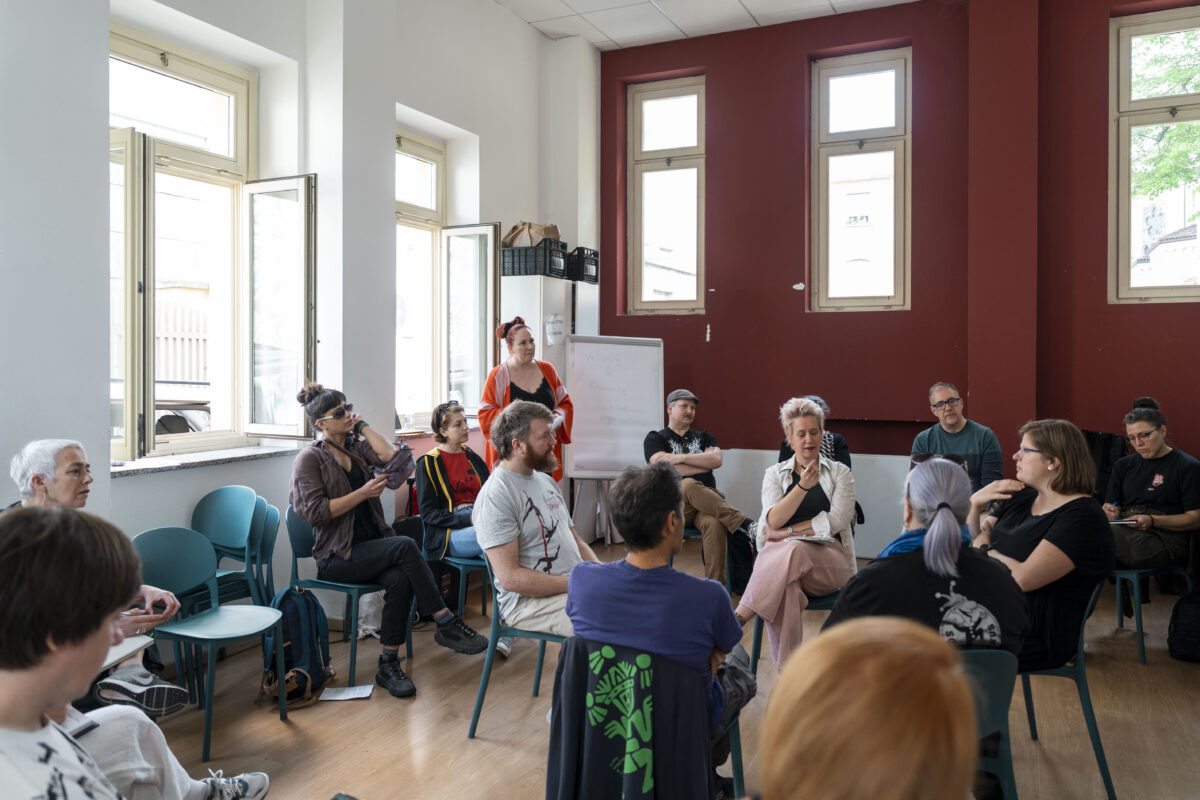
At the Turin seminar, Katja also facilitated a fishbowl discussion on the wellbeing and resilience of cultural organisations. In the discussion, four participants sat in the inner circle speaking, while the outer circle observed and joined in at intervals, bringing multiple perspectives to the topic.
At the heart of the discussion was the question of how cultural organisations can operate sustainably in uncertain conditions. Sustainability was seen as a continuous balancing act between everyday realities and available resources. Financial challenges, scarcity of resources, and workload pressures emerged as key issues.
Trust, community, and appreciation were identified as key building blocks of sustainability. The discussion also emphasised humanity in working life, preventing burnout, and the unsustainability of constant performance. Safe spaces where vulnerability is possible, as well as involving young people and strengthening community support, were seen as important factors in building resilience. Finally, the discussion turned toward the future. Themes such as openness to change and accepting failure emerged. The discussion highlighted that sustainability is built through continuous dialogue between people, values, and structures.